Sessions
2026 Program Topics
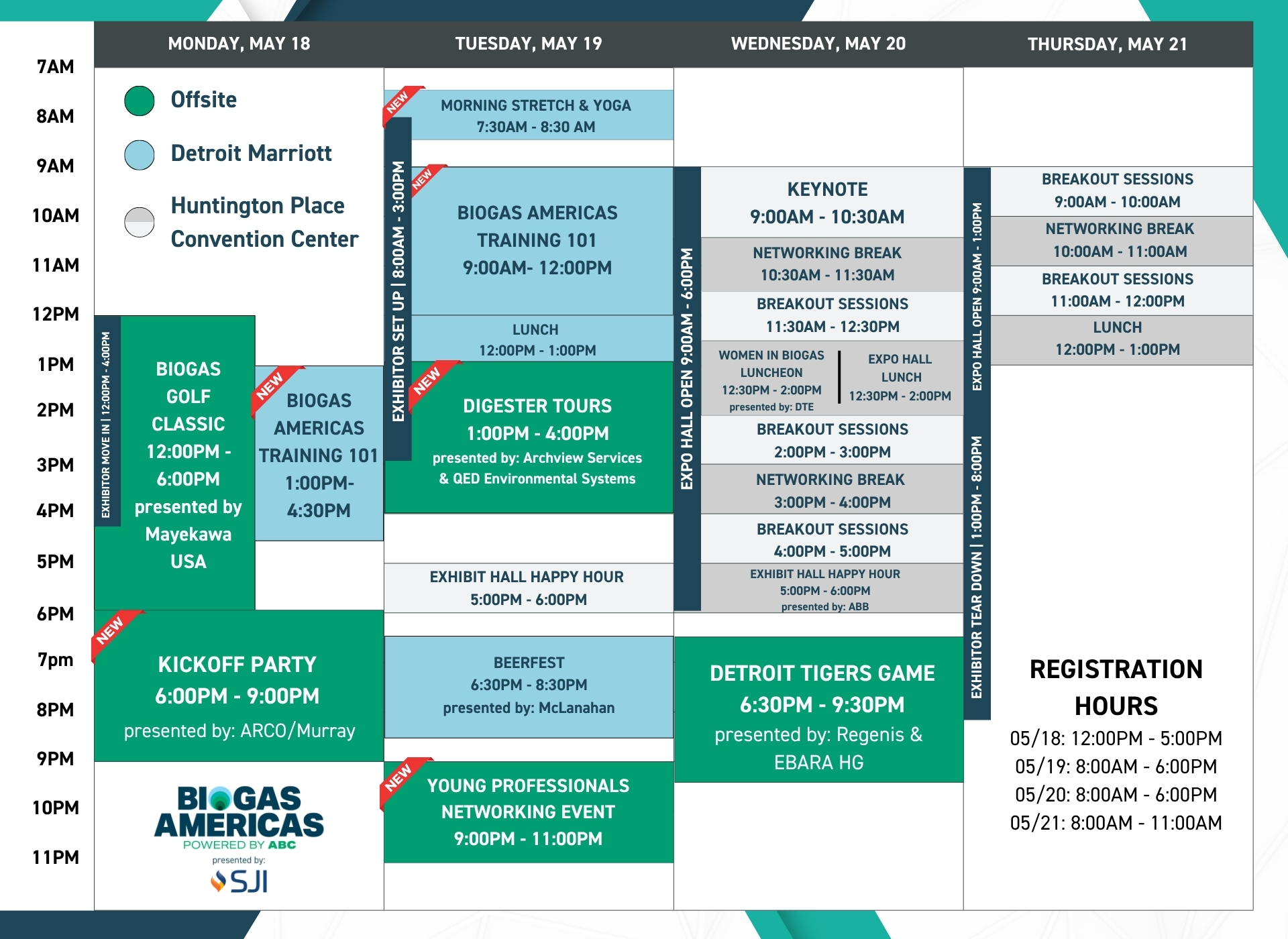
Hit the ground running at BIOGAS AMERICAS with this interactive pre-conference training designed to build your personalized conference plan and help you connect before the conference even begins! Whether you’re new to the industry or want a focused refresher, industry experts will equip you with the core concepts featured throughout the conference, using the exhibit floor and panels as your foundation. Jump into Day One ready to make every conversation count!
You will walk away with:
– A physical roadmap to optimize your time on the floor, talking to the right exhibitor for your company success
– Deepened knowledge on the panels; industry experts will prime you to be able to better note key take aways from each panel
– Site visits: Digester Tours included!
– And maybe most importantly, new friends and business contacts. This is not a training where you sit still and keep to yourself. We will engage and have fun; learning will never have felt so easy!
The training takes place Monday and Tuesday at the Detroit Marriott at the Renaissance Center, making it the perfect way to learn, connect, and set yourself up for a great week.
Lauren Toretta, President & CEO CH4 Biogas
Lizzy Reinholt, President, Peaks Renewables, Summit Utilities, Inc.
Rashi Akki, CEO, Ag-Grid Energy LLC
Starlee Sykes, CEO, Archaea Energy, bp
Skye Austin | Moderator, RNG Sales Director, Stark Tech
Ryan Harb, Director, New Market Development, Ameresco
Lizzy Reinholt, President, Peaks Renewables, Summit Utilities, Inc.
Siva Ariyapadi, Global Business Manager, Bioenergy, ExxonMobil
Mark Britton, Commercial Director, Seaside LNG
Heather Dziedzic, VP of Policy, ABC
Maritime shipping is often cited as a promising offtake market for low-carbon fuels, but uncertainty remains. This session will examine the technical work underway at IMO and how it may shape the Net-Zero Framework and future low-carbon fuel demand in maritime shipping. Panelists will explore near-term risks, policy gaps, and realistic timelines, while also discussing domestic pathways for maritime offtake in the U.S., helping developers and producers assess if, how, and when this market can become viable.
Skye Austin, RNG Sales Director, Stark Tech
Steven Woodard, Chief Innovation Officer, Onterris
Meghan Stackhouse, Principal, GatorWolf Environmental
John Gardella, Shareholder, CMBG3 Law
PFAS—forever chemicals—used to just be a topic reserved for discussions around water, food, and soil. But new questions about whether PFAS is in biogas and how governments might regulate that as well broaden this discussion. What the science says so far, what regulatory compliance might look like, and how producers and buyers can prepare for the future will all be discussed.
Randy Beck, Senior Director, Renewable Energy, WM
Frank Jere, Director – Technical Services, DTE Biomass
Doug Tholo, Energy Project Developer, Mead & Hunt
Eric Hopkins, Manager, GFL Renewables
Nicole Neff, Chief Revenue Officer, LoCI Controls Inc.
The landfill gas market has evolved far beyond basic collection and control, and it continues to shift. This session will examine how landfill gas has progressed to electricity generation and RNG production, and how new approaches to carbon intensity, measurement, and optimization are reshaping project economics and end-use decisions. Panelists will explore where the market is headed next and how owners and developers can adapt to changing technologies, regulations, and demand signals across power and gas markets.
Cyn French, Co-Founder, EVP Corporate Affairs, LF Bioenergy
Zoey Nelson, Dairy Manager, Brooks Farms
Greg Bethard, CEO, High Plains Ponderosa Dairy
Corey Geiger, Lead Economist-Dairy, CoBank
Trey Forsyth, Vice President, Government & Regulatory Affairs, National Milk Producers Federation
Farmers are essential partners in building biogas projects that last, but long-term success depends on more than good operations: it requires consistent, dependable policy frameworks that farmers, developers, and investors can plan around. This candid conversation brings together farmers, developers, operators, and policymakers to share what makes on-farm digesters work in practice, from aligning goals and timelines to managing day-to-day realities and community expectations. Panelists will highlight what producers prioritize, how strong partnerships are built, and why stable U.S. market and policy signals are critical to scaling projects at the source.
Kim Martin, Vice President of Development, Vanguard Renewables
Thomas Gratz, Sales Manager, Kanadevia Inova
Umesh Akki, COO, Ag-Grid Energy LLC
Floriano Ferreira, VP Engineering & Business Development, Generate Upcycle
Craig Lovett, SVP Sales & Strategy, Vanguard Renewables
Manure and food waste represent some of the largest untapped opportunities in the U.S. biogas market, but scaling co-digestion isn’t simple. This session explores what it takes to develop and operate successful projects, from coordinating multiple feedstock partners and managing logistics to navigating permitting, D3 RIN qualification, and operational complexity. Hear how developers are overcoming real-world challenges to build larger, efficient, more integrated co-digestion projects that pencil.
Nicholas Bonkoski, Domain Leader – AD Systems, Veolia
Mandy Sheposh, Director of Development – Water, Wastewater & Bioenergy, Johnson Controls
James Ouzts, Environmental Services Department Manager, City of Grand Rapids
Ravi Bhaskar, Senior Business Development Manager, Water Energy Nexus, OPTERRA Energy
Dru Whitlock, VP, Chief Technologist Biosolids, Carollo Engineers
Municipal biosolids programs are under growing pressure to control costs, manage risk, and meet tightening regulatory and public expectations. This session explores how utilities and municipalities are evaluating biogas and energy recovery projects in wastewater through the lenses of compliance, ratepayer impact, and long-term operational value. Panelists will discuss decision frameworks, including the role of public-private partnerships (P3s), and how alternative delivery and funding models can help advance biosolids-to-energy projects that may otherwise be difficult in today’s tax and financing environment.
Jerome Brenneman, Director, CO2 Business Development, Archaea Energy, a bp company
Noah Leinwand, Co-Founder, Alchemy CO2
Erica Chase, President, CleanCycle Carbon, EFI USA
Brian Polley,Tax Director – Renewable Energy Incentives, Christianson CPAs and Consultants
Lauren Porambo,Director, Project and Carbon Dioxide Support, B&R Compliance Associates, LLC
CO₂ is increasingly part of the biogas conversation, but the opportunity is nuanced, market-specific, and evolving. This session takes a clear-eyed look at CO₂ as a biogas co-product, examining where demand is emerging, what commercial pathways exist today, and where the economics do (and do not) make sense. Panelists will discuss why CO₂ is gaining attention now, what buyers are looking for, and how developers can assess whether CO₂ recovery is a viable complement to their project rather than a silver bullet.
Ryan Bates, Business Development Manager, Marubeni Americas Corporation
Nervy Santiago, CEO and General Manager, Alterna Verde Corporation
Mike McCurdy, Managing Director – Fuels & Power, ICF
Takashi (Bob) Nakashima, Director, Tokyo Gas GX1
Tyler Cole, Head of US Stakeholder Engagement, Tree Energy Solutions
While much of the US biogas market focuses on domestic credit prices and policies, plus maritime and European offtake, demand in Asia for US RNG and bio-LNG has been growing. Become familiar with Japan’s proposed renewable gas mandate, Singapore’s biomethane sandbox, data center demand, and other large energy users in the region. Might these markets be a good fit for your business?
Brad Pleima, President, EcoEngineers
Tom Moffett, SVP – Low Carbon Fuels, Anew Climate
Mike O’Laughlin, CEO, Vanguard Renewables
Robert Frank, Director, Biogas Origination, bp
Offtake remains one of the biggest bottlenecks to advancing biogas projects, and the landscape is shifting fast. This session provides a clear-eyed digest of today’s offtake markets, covering where opportunities exist, what’s changed recently, and what’s slowing deals down. Panelists will discuss practical steps needed to “unstick” offtake and move projects forward in today’s uncertain market.
Cassandra Farrant, Head of Environmental Programs and Regulatory Affairs, Amp Americas
Sam Lehr, EVP of Policy, Molecule Group
Anna Redmond, Managing Consultant, Life Cycle Associates
Maya Patel, Natural Resources Specialist & Policy Analyst, Office of the Chief Economist, U.S. Department of Agriculture
Carbon accounting is changing, and those changes are already influencing markets, project economics, and policy outcomes. This session breaks down recent updates to GREET, tax policy, and the Greenhouse Gas Protocol, including specific case studies. Panelists will explore how these accounting shifts affect crediting, compliance, and the ability to create credible, bankable demand for low-carbon fuels. Managing Consultant
Submit your speaker suggestions for 2026 BIOGAS AMERICAS!